


The concept of constructing architectural marvels beyond Earth’s atmosphere demands a radical rethinking of both function and form. Zero-gravity environments challenge traditional building paradigms, pushing designers to explore **microgravity**-tailored solutions. This article delves into the complexities of creating livable spaces in orbit, on lunar surfaces, and en route to Mars, emphasizing the interplay of material science, novel building techniques, and advanced technologies.
Environmental Dynamics in Microgravity
Space environments are characterized by extremes of temperature, vacuum conditions, and cosmic radiation. In the absence of gravity, everyday assumptions about load-bearing walls, verticality, and circulation corridors dissolve. Designers must account for orbital debris strikes, rapid thermal fluctuations, and the absence of convection for heat transfer.
Vacuum and Thermal Control
In the void of space, temperatures can range from -150°C to +120°C. Without an atmosphere, conductive and radiative heat transfer dominate. Insulation systems must integrate multi-layered shielding, reflective coatings, and phase-change materials. Heat dissipation becomes a critical requirement, necessitating active thermal management loops and heat pipes that ferry warmth from interior zones to external radiators.
Radiation and Shielding
Cosmic rays and solar particle events pose severe threats to human occupants and sensitive electronics. Effective **radiation shielding** combines regolith-based barriers for lunar outposts, hydrogen-rich polymers, and water-based protective layers. Innovative concepts explore 3D-printed walls infused with regolith or polyethylene fibers to maximize protection while minimizing mass.
Atmospheric Containment
Maintaining a stable internal atmosphere requires airtight membranes and redundant seals. Pressure differentials must be continually monitored, and emergency repair kits for micro-meteoroid punctures form part of standard equipment. The design of docking ports and airlocks employs advanced composites to withstand repeated use under fluctuating stresses.
Core Design Principles
The fundamental approach to zero-gravity architecture hinges on modularity, adaptability, and resource efficiency. Each structural component must serve multiple purposes, minimizing redundant mass.
Modular Construction
Deployable **modular construction** systems allow habitats to expand over time. Prefabricated nodes can be linked via flexible corridors, accommodating both crew quarters and laboratories. Standardized interfaces simplify assembly by robotic arms and human EVA operations, reducing the reliance on heavy machinery.
- Inflatable habitats that deploy from compact containers
- Rigid truss frameworks assembled from lightweight alloys
- Expandable lattice structures that lock into place
Structural Adaptability
Given the unpredictability of space missions, architectural frameworks must exhibit **structural adaptability**. Components can be reconfigured for research tasks, emergency refuge, or storage. Shape-memory alloys and smart polymers enable dynamic morphing of walls and partitions, responding to new operational requirements.
Sustainable Materials and In-Situ Resource Utilization
Transporting materials from Earth is prohibitively expensive. Embracing **sustainable materials**, designers tap into local resources such as lunar regolith or Martian soil. In-situ Resource Utilization (ISRU) techniques convert raw matter into construction feedstock through sintering, 3D printing, and chemical extraction processes. This approach dramatically reduces logistical burdens and fosters long-term settlement strategies.
Technological Integration and Life Support
Space habitats are ecosystems that integrate architecture with complex engineering subsystems. Seamless interaction between structural elements and life support magnifies overall reliability.
Life Support and Closed-Loop Ecosystems
Maintaining human life in space demands continuous recycling of air, water, and waste. Advanced **life support** systems employ photobioreactors that harness algae to regenerate oxygen and sequester carbon dioxide. Greywater treatment units recycle moisture for plant cultivation, while composting modules process organic waste into fertilizer.
Regenerative Design and Energy Management
Adopting **regenerative design** means capturing every joule of available energy. Solar arrays with adjustable orientation track the sun, while energy storage batteries and fuel cells ensure uninterrupted power during eclipses or dust storms on Mars. Thermal energy recuperation systems salvage heat from machinery and life support units to maintain comfortable interior temperatures.
Autonomous Systems and Robotics
Given the hazards of extravehicular activity, robotic assemblers and drones perform routine inspections and repairs. **Autonomous systems** navigate exterior surfaces, apply sealant patches, and inspect structural joints. Internally, AI-driven maintenance bots monitor atmospheric variables, diagnose faults, and execute preventative measures before malfunctions escalate.
Human Factors and Psychological Well-Being
Isolation, confinement, and the absence of natural landscapes can undermine mental health. Architectural design must foster a sense of place and community to sustain morale on extended missions.
Spatial Organization and Privacy
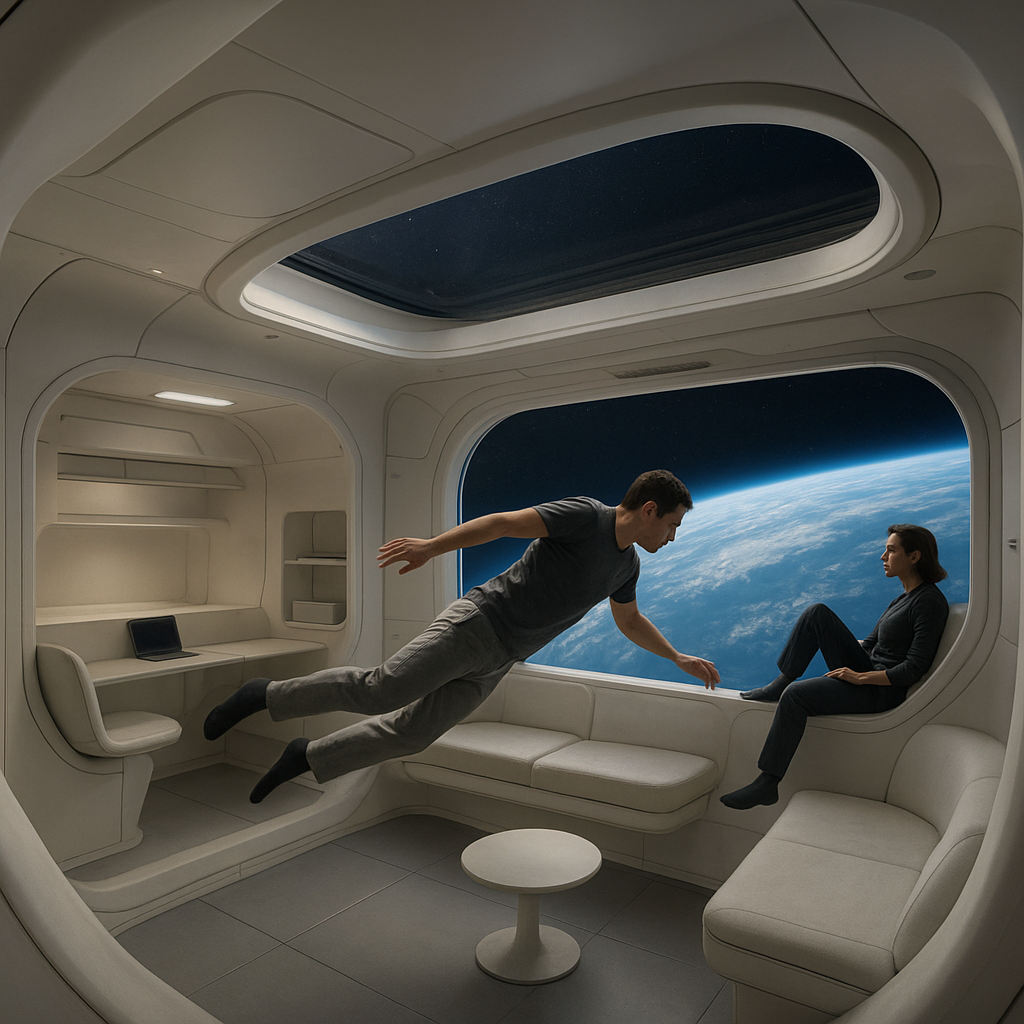
Enclosures are subdivided into private quarters, communal areas, and flexible workspaces. Transparent smart glass panels allow adjustable opacity, creating visual connections or privacy as needed. Personalized modules can accommodate sensory preferences, such as light spectrum adjustments and ambient soundscapes.
Biophilic Elements and Virtual Windows
To counter sensory deprivation, habitats integrate live plant growth walls and hydroponic gardens. **AI-driven** displays simulate Earthly vistas, from forest paths to ocean horizons. Cytotropic projections and holographic skylights mimic natural weather cycles, reinforcing circadian rhythms.
Ergonomic Interfaces and Microgravity Mobility
Movement in zero-G relies on handrails, footholds, and magnetized boots. Interior surfaces are free of sharp edges and obstacles. Furnishings are designed for tethering and secure storage; laptops and tools adhere to mounting points. Interfaces adapt to microgravity gestures, allowing intuitive control of environmental systems.
Applications and Emerging Trends
Zero-gravity architecture extends beyond habitats to spacecraft interiors, orbital laboratories, and deep-space waystations. Pioneering missions are already prototyping next-generation structures for NASA, ESA, and private space firms.
- Apollo-era lessons inform modular lunar base concepts.
- Commercial stations propose inflatables with expandable volumes up to 500 cubic meters.
- Mars transit vehicles emphasize combined habitat and research functions to optimize mass and crew time.
Innovations such as magnetic shielding, variable-stiffness materials, and plasma-based airlocks hint at future research directions. Collaboration between architects, engineers, biologists, and AI specialists will drive the next wave of breakthroughs, making sustainable human outposts a reality within decades.
Conclusion of Forward-Looking Visions
Zero-gravity architecture embodies the convergence of **modular construction**, **sustainable materials**, and **autonomous systems** to meet humanity’s ambitions among the stars. As exploration transitions from brief sorties to permanent settlement, design ingenuity will pave the way for flourishing communities in the cosmos.